

Imagine you publish a really good article about SEO.
You research the topic, optimize the title, add keywords, write a meta description, and hit publish.
A few weeks later, you check Google.
Nothing.
Your page is sitting on page five, while another website with a weaker article ranks above you.
What went wrong?
Sometimes the problem isn’t the article. It’s the website around the article.
Google doesn’t judge every page in isolation. It also sees how your content fits into the rest of your website: whether you cover a subject consistently, how your pages connect, and whether the information looks useful and trustworthy. This is where topical authority in SEO comes in.
And here is one misconception to clear up first:
Topical authority does not mean publishing 100 articles about the same subject.
It means building the right coverage around a topic and connecting it well.
Let’s look at how to do that.
What Is Topical Authority in SEO?
Topical authority is the depth and breadth of useful content a website has around one subject.
If a business wants to be known for SEO, one article called “What Is SEO?” isn’t enough.
A stronger structure would cover:
- Keyword research
- Search intent
- On-page SEO
- Technical SEO
- Internal linking
- Local SEO
- Content strategy
- AI search
- SEO measurement
These pages don’t exist just to target different keywords.
They answer different questions connected to the same subject.
One honest note: “topical authority” is an industry concept, not an official Google term. Google does not publish a “topical authority score” or confirm it as a ranking factor.
What Google does say is to create helpful, reliable, people-first content and organize your website so users and search engines can understand it.
Topical authority is a practical way to work toward that kind of useful, well-organized website.
So the real question is not:
“How many articles do I have?”
It is:
“How completely does my website help someone understand and solve this problem?”
Why Topical Authority Matters More in 2026
Search is becoming more conversational.
A user might ask:
“How do I improve my website SEO?”
Then:
“What should I fix first?”
Then:
“Does internal linking actually help?”
Then:
“How does AI search change this?”
These may look like separate searches, but they are really connected parts of the same information journey.
Google has also described AI Mode as breaking complex questions into several related sub-searches, a process Google calls query fan-out.
Google also explains that its AI features in Search rely on the same underlying foundations as normal SEO.
So SEO basics still matter.
What changes is how people discover and consume answers.
A website with connected, useful content can serve users at different stages of their search journey.
That is why I wouldn’t build an SEO strategy around isolated pages anymore.
I’d build it around connected topics.
Topical Authority vs. Keyword Targeting
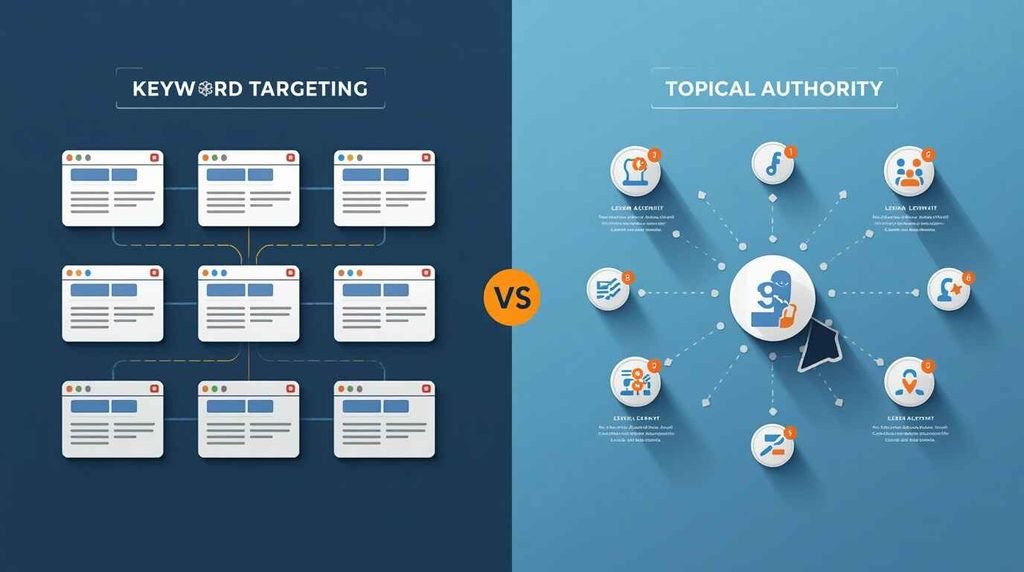
Say your keyword is “local SEO.”
A keyword-first approach writes one article and repeats the phrase.
A topical approach asks:
What does someone actually need to know about local SEO?
That could include:
- Google Business Profile
- Reviews
- Local citations
- NAP consistency
- Local landing pages
- Service-area businesses
- Local search intent
Now you don’t have one page for one keyword.
You have a topic ecosystem.
But don’t create a page for every tiny variation.
Dozens of near-identical pages can make a site worse, not better.
The goal is coverage, not volume.
How to Build Topical Authority: 10 Steps
1. Choose One Core Topic
Start with what you want your business to be known for.
If your website is small, don’t try to become an authority on 20 subjects at once.
Pick one core topic, such as SEO, and go deeper before you widen.
2. Create a Pillar Page
A pillar page is a broad guide to the core topic, such as:
“SEO in 2026: A Complete Guide.”
It gives the big picture and links out to focused articles on:
- Technical SEO
- Search intent
- Internal linking
- Local SEO
- AI search
The pillar page gives your readers a starting point, while the supporting articles help them explore specific questions in more detail.
3. Build Topic Clusters

Think of your website as a map.
The core topic is the center, and related subjects branch out from it.
Each branch can have its own supporting articles.
The relationships must make sense.
Don’t create a page only because a keyword tool shows search volume.
Create it because your audience has a real question.
Where can you find these subtopics?
Start with places where real questions already appear:
- Search Console queries and pages
- Google’s “People also ask” results
- Questions customers ask you
- Relevant competitor headings
- Questions that naturally come up while researching your main topic
The goal is not to collect hundreds of keywords.
The goal is to understand the questions surrounding your core topic.
4. Connect the Cluster With Internal Links
Internal links help readers go deeper, and they also help search engines discover pages and understand how they relate.
For example, when explaining how AI is changing search, you can link to our guide:
How AI Is Changing SEO in 2026
When discussing AI Overviews and AI Mode, you can link to:
How To Optimized Your Website For Google AI Overviews & AI Mode in 2026
Use descriptive anchor text, and link only where the destination genuinely helps the reader.
5. Cover Different Search Intents
Don’t publish only beginner-level informational posts.
A complete website answers different types of questions.
- Informational: “What is technical SEO?”
- Problem-focused: “Why isn’t my website ranking?”
- Commercial: “SEO services for small businesses”
- Comparison: “SEO agency vs freelancer”
- Transactional: “Hire an SEO agency”
Educational content should connect to the real services or solutions your business offers.
That is when content becomes a business asset and not just a traffic exercise.
6. Add Experience, Not Just Information
AI can summarize common SEO advice in seconds, so generic information is now easy to produce.
If your article says what hundreds of other websites already say, there may be little reason for someone to remember your website.
Add things that only come from real work:
- Your own workflows
- Screenshots from your tools
- Mistakes you’ve seen
- Before-and-after explanations
- Industry-specific examples
- Your own observations
Never invent statistics or studies.
If you haven’t tested something, say so.
Trust comes from being accurate, not from sounding confident.
7. Don’t Confuse Topical Authority With Keyword Stuffing
Repeating:
“SEO strategy, SEO services, SEO agency, SEO expert, SEO company”
in every paragraph doesn’t show expertise.
It makes the page difficult to read.
Google’s systems can understand related concepts and variations, so write naturally for the person first.
Topical authority is about useful coverage, not repeating the same keyword again and again.
8. Fix Your Technical Foundation
Great content can’t fix every technical problem.
Before you invest months in content, check that Google can access and understand your important pages.
Some basics include:
- Indexing and crawlability
- Canonical URLs
- Mobile usability and HTTPS
- Page speed
- XML sitemap
- Redirects
- Structured data where appropriate
Google’s Search Essentials cover these basic requirements.
You don’t need a complicated setup.
You need a website that works properly and gives search engines access to the content you want indexed.
9. Build Credibility Beyond Your Website
Your reputation also exists outside your website.
This can include:
- Industry mentions
- Relevant directories
- Partnerships
- Interviews
- Podcasts
- YouTube
- Reviews
- Genuine references from other websites
Don’t turn this into a numbers game.
200 low-quality profiles will not automatically build a strong reputation.
Focus on being present in places that are actually relevant to your business and audience.
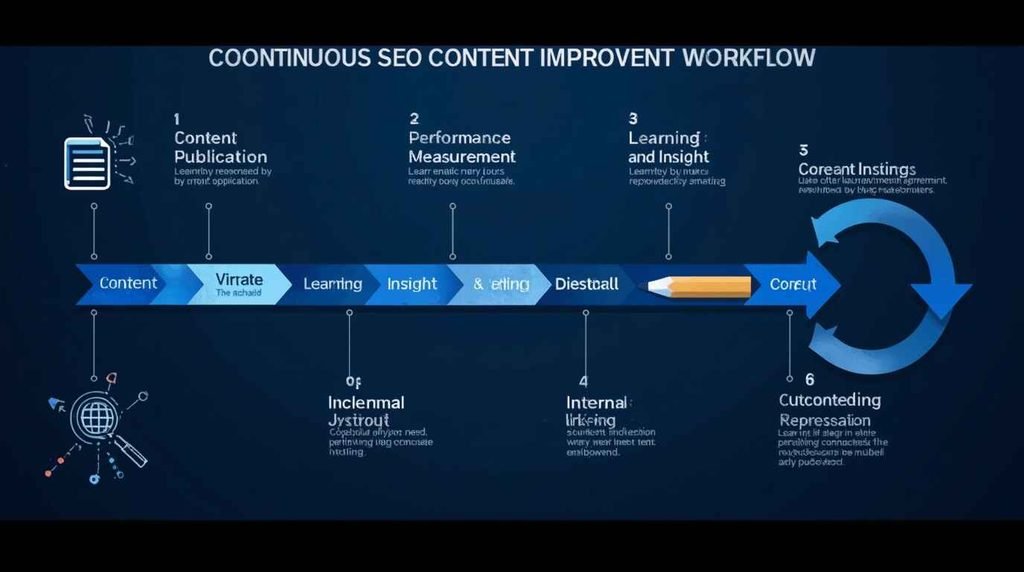
10. Measure and Improve
Publishing is not the finish line.
Once your pages start getting impressions in Google Search Console, look at which queries they appear for.
You may discover:
- New topics
- Missing sections
- Weak internal links
- Pages that need updating
- Questions you haven’t covered yet
Publish → Measure → Learn → Improve → Connect → Repeat
Google also introduced dedicated Generative AI performance reporting in Search Console in 2026.
Use the data as a learning tool rather than obsessing over one individual metric.
Example: A Simple Topic Cluster
This is a hypothetical example, not a real client result.
Imagine a small local business that wants to be known for local SEO.
| Role | Page Idea | Search Intent |
|---|---|---|
| Pillar | Local SEO: A Complete Guide | Informational |
| Cluster | How to Set Up and Optimize a Google Business Profile | Informational |
| Cluster | How to Get More Google Reviews | Problem-focused |
| Cluster | Local SEO Mistakes That Stop You Ranking | Problem-focused |
| Cluster | Local SEO Services: What’s Included and What It Costs | Commercial |
| Cluster | Local SEO Agency vs Freelancer | Comparison |
| Conversion | Local SEO Service Page | Transactional |
Notice that every page answers a different question.
Every supporting page can link back to the pillar.
The conversion page then connects the content cluster to the actual service.
That is the difference between a blog and a topic cluster.
Common Topical Authority Mistakes
- Treating topical authority as an SEO hack instead of a content-quality strategy
- Publishing dozens of AI-generated articles just to make the website look bigger
- Covering too many unrelated topics at once
- Ignoring technical SEO
- Adding internal links without a real reason
- Never updating or measuring published content
- Creating pages for every tiny keyword variation
A smaller website with genuinely useful, connected resources can be more valuable than a website filled with shallow articles.
Quick Topical Authority Checklist
- Pick one core topic.
- List the main subtopics and questions people ask.
- Map each question to a search intent.
- Create one pillar page.
- Create supporting pages for specific questions.
- Link pages together naturally.
- Add real examples and experience.
- Check your technical SEO.
- Earn genuine mentions and references.
- Review Search Console and update regularly.
Frequently Asked Questions
Topical authority means your website covers a subject in enough depth and with enough useful, connected content that users and search engines can understand that your website genuinely helps people with that topic.
No.
Google does not publish a topical authority score. It is an industry concept.
It is still useful as a content strategy because it encourages you to create helpful, well-organized content around a subject.
There is no magic number.
The right number depends on the topic, audience, competition, and questions you need to answer.
A focused set of useful, well-connected pages is a better starting point than publishing a large number of shallow posts.
A pillar page is a broad guide to a main topic.
A topic cluster is the pillar page plus supporting articles that go deeper into specific questions, with the pages connected through relevant internal links.
There is no guaranteed format or trick that makes a website appear in AI-generated answers.
However, creating useful content that answers the main question, related questions, and follow-up questions can help your website provide useful information in conversational search.
Yes, but be realistic.
Start with one focused topic instead of trying to cover everything.
A small website can become genuinely useful around a narrow subject, although ranking for highly competitive searches can take time.
It depends on your competition, content quality, website, and overall SEO foundation.
Don’t expect meaningful results in a few days.
Track impressions and clicks in Google Search Console over time and improve your content based on what you learn.
AI can help with research, outlines, organizing ideas, and identifying possible content gaps.
But publishing mass-produced generic articles will not automatically build authority.
Add real experience, examples, useful information, and accuracy to everything you publish.
Final Thoughts
Topical authority is not about convincing Google that you’re an expert.
It is about actually building a website that shows depth, relevance, and usefulness.
Choose a subject.
Understand the questions around it.
Create genuinely useful content.
Connect related pages.
Add your own experience.
Keep the technical foundation clean.
Then measure and improve.
As search becomes more conversational and AI-powered, individual keyword rankings are only one part of the picture.
Google’s guidance for generative AI search recommends continuing to follow foundational SEO practices while focusing on useful, unique, and well-organized content.
A strong website should be able to answer the main question, the follow-up question, and the question that comes after that.
That is what a useful topic-focused website looks like.
Don’t build a bigger content library just to have more pages. Build a website that becomes genuinely useful.
Want Help Planning Your Content Structure?
Explore our:
Or get in touch with NorthStar Marketing Hub through the website.