
How AI Is Changing SEO in 2026: What Actually Matters Now
AI is not killing SEO. It is changing what SEO is expected to accomplish.
For years, SEO was largely built around a familiar process: research keywords, create a relevant page, optimize titles and headings, build links, and improve rankings.
That process still matters.
But search has changed.
A person looking for information in 2026 may no longer follow the traditional path of typing a query into Google, clicking the first result, and reading one article. They may see an AI-generated answer, ask a follow-up question, compare several sources, watch a video, visit a brand’s website, and return to search again before making a decision.
This creates a more complicated environment for businesses.
The question is no longer simply:
“How do I rank #1?”
A better question is:
“How do I make my business visible, useful and trustworthy throughout the search journey?”
That is the real impact AI is having on SEO in 2026.
How AI Is Changing Search
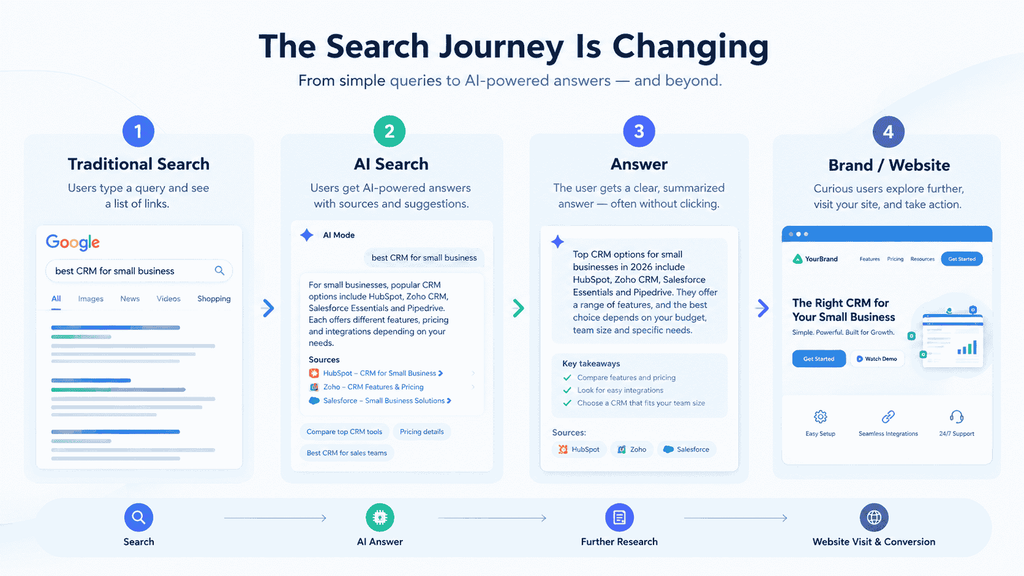
Google’s AI Overviews and AI Mode are changing how users interact with search by providing synthesized answers and allowing more conversational exploration. The fundamentals of SEO still matter, but the way those fundamentals translate into visibility is changing.
This is important because there is a tendency in the SEO industry to treat AI search as an entirely separate discipline.
It isn’t.
The fundamentals remain:
- Crawlable and indexable websites
- Helpful content
- Clear site structure
- Relevant internal links
- Strong technical SEO
- Accurate information
- Good user experience
- Demonstrable expertise and trust
What is changing is how those fundamentals translate into visibility.
A webpage may now influence a user without receiving the traditional organic click.
AI Search Is Creating a New SEO Visibility Problem
Traditional SEO has historically focused heavily on rankings and organic traffic.
AI search introduces another layer: citation and brand visibility inside generated answers.
Imagine someone searches:
“What is the best CRM for a small business?”
Instead of seeing ten blue links, the user may receive a synthesized answer that discusses several CRM platforms and provides supporting sources.
Your company might receive:
- A traditional organic ranking.
- A mention in an AI-generated answer.
- A citation to your website.
- A branded search later.
- A direct visit after the user has already learned about you elsewhere.
These are different forms of visibility.
That means SEO measurement needs to become broader.
Instead of watching rankings alone, businesses should monitor:
- Organic impressions
- Organic clicks
- Click-through rate
- Rankings
- Conversions
- Brand searches
- Assisted conversions
- Referral traffic
- AI-search visibility where measurable
- Mentions and citations
The exact reporting capabilities available will continue to evolve, so marketers should avoid building their entire measurement system around one AI-search metric.
AI Has Made Average Content Cheap
This may be the biggest change content marketers need to understand.
AI can produce an article about almost any common topic within seconds.
That means information itself is becoming cheaper.
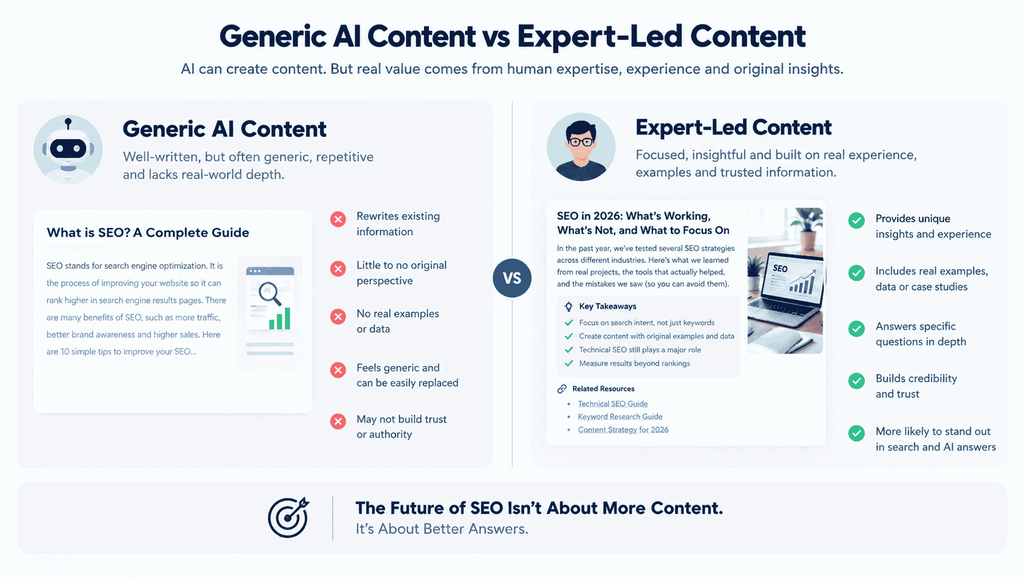
If your article simply explains what SEO is, lists ten basic SEO tips, and repeats information already available on hundreds of websites, there is little reason for a reader to choose your page.
The competitive question has changed from:
“Can we create content?”
to:
“What can we add that isn’t already everywhere?”
That difference matters.
Strong content can include:
- Original research
- First-hand observations
- Expert commentary
- Product testing
- Screenshots
- Data analysis
- Detailed examples
- Interviews
- Customer questions
- Industry-specific recommendations
- Lessons from failed approaches
You don’t need all of these in every article.
But the more competitive the topic, the more important it becomes to provide something beyond a rewritten version of existing information.
First-Hand Experience Is Becoming a Major Advantage
Consider two articles targeting the same topic.
The first explains a marketing strategy using general definitions and common advice.
The second explains how the strategy works in practice, what decisions need to be made, what mistakes commonly happen, what should be measured, and what situations require a different approach.
The second article has something valuable:
experience.
This is one reason businesses should not outsource all of their knowledge to AI.
AI can help organize information.
It can help generate ideas.
It can help summarize research.
It can help identify gaps.
But it does not automatically possess your company’s experience.
If you have worked with customers, sell a product, run campaigns, conduct research or solve a particular problem repeatedly, that knowledge should become part of your content.
That is difficult for competitors to copy.
AI-Assisted Content Is Different From AI-Generated Content
This distinction deserves more attention in 2026.
AI-generated content
AI creates most of the article with little meaningful human contribution.
The result can be grammatically correct but generic, repetitive or poorly supported.
AI-assisted content
A human defines the purpose, researches the subject, contributes expertise, verifies claims, adds examples, edits the structure and takes responsibility for the final information.
AI may assist with:
- Research organization
- Outlining
- Brainstorming
- Editing
- Summarization
- Content repurposing
- Identifying unanswered questions
The important point is not whether AI touched the article.
The important point is whether the final article deserves to exist.
For a digital marketing agency, this distinction is especially important. AI can make research and production more efficient, but strategy still requires understanding the business, audience, competition and commercial objective.
Keyword Research Is Becoming More About Problems Than Phrases
Keyword research is still fundamental to SEO.
But experienced SEO work does not stop at search volume.
Suppose you want to rank for:
“CRM software.”
The keyword itself tells you very little about the entire decision process.
A potential customer may also want to know:
- Which CRM is suitable for a small business?
- How much does CRM software cost?
- How difficult is migration?
- Which CRM works with WhatsApp?
- What features does a sales team actually need?
- How long does implementation take?
- What are the alternatives?
- What happens after purchase?
These searches represent different stages of the same problem.
This is why modern content strategy should map topics to customer questions and decisions, rather than producing one article for every keyword variation.
Content Structure Matters More Than Ever
Good structure serves two audiences at the same time:
People and machines.
A well-structured article makes it easier for readers to find the answer they need and easier for search systems to understand the relationship between different sections.
Use:
- One clear H1
- Descriptive H2s
- Useful H3s
- Short paragraphs
- Lists where appropriate
- Tables for genuine comparisons
- Clear definitions
- Specific examples
- Descriptive internal links
Don’t structure content for an imagined “AI algorithm” at the expense of humans.
A table should exist because it makes information easier to compare—not because someone claimed tables automatically increase AI citations.
There is no formatting trick that guarantees inclusion in an AI-generated answer.
The underlying information still needs to be useful and trustworthy.
Zero-Click Searches Change What Content Businesses Should Create
Some searches can now be answered without a website visit.
For example:
“What is a meta description?”
A user may receive a satisfactory answer directly in search.
This creates a difficult business question:
Why should I spend resources creating content that users don’t need to click?
The answer is to understand the role of different content types.
Simple informational queries may generate visibility without generating many clicks.
Commercial content can be different.
Consider:
- Product comparisons
- Pricing information
- Alternatives
- Buying guides
- Case studies
- Product-specific tutorials
- Implementation guides
- Industry solutions
These pages help people make decisions that often require more than a short AI-generated answer.
The goal is not to stop creating informational content.
The goal is to connect useful information with the problems your business actually solves.
Brand Authority Is Becoming Part of the SEO Equation
A website does not exist in isolation.
Search systems can encounter information about a business across many sources.
That makes your broader digital presence important.
Relevant signals can include:
- Industry publications
- Independent reviews
- Expert contributions
- Podcasts
- YouTube
- Professional profiles
- Business directories
- Partnerships
- Original research
- Consistent company information
This does not mean creating hundreds of low-quality profiles or paying for meaningless mentions.
It means building a legitimate reputation around the subject your business wants to be known for.
For an agency, that means your own website should demonstrate the same marketing principles you recommend to clients: clear positioning, useful content, strong technical foundations and a consistent brand presence.
What This Means for Businesses Working With an SEO Agency
AI has changed the tools available to marketers, but it has not removed the need for strategy.
A business still needs to answer practical questions:
Who are we trying to reach?
What are they searching for?
Which searches can generate business value?
What information do they need before contacting us?
Why should they trust us instead of another company?
How will we measure whether SEO is contributing to growth?
This is where SEO should connect with the rest of digital marketing.
Search visibility can bring qualified visitors, but businesses may also need paid advertising, social media, content marketing and lead-generation systems to turn attention into opportunities.
At NorthStar Marketing Hub, the approach is built around combining AI-powered insights with human expertise and creating strategies around a business’s goals, audience and industry rather than using a one-size-fits-all approach.
The important principle is simple:
Technology should support the strategy—not become the strategy.
Technical SEO Has Not Become Less Important
There is a common misconception that AI makes technical SEO less relevant.
It doesn’t.
AI can change how information is presented, but search systems still need to access and understand websites.
Your technical foundation should therefore include:
- Crawlable pages
- Correct indexation
- Clean canonicalization
- Logical internal linking
- Mobile usability
- Fast performance
- Secure HTTPS
- Proper redirects
- Accessible important content
- Accurate structured data where appropriate
Technical SEO isn’t exciting.
But a brilliant article that cannot be properly crawled or indexed is still a poor SEO asset.
What SEO Professionals Should Stop Doing in 2026
AI has made some old habits particularly risky.
Stop publishing content just because a keyword has search volume.
Search volume doesn’t guarantee business value.
Stop assuming longer articles are automatically better.
A 2,500-word article can be worse than a focused 900-word answer if the extra words add nothing.
Stop producing dozens of similar AI articles.
More URLs do not automatically create more authority.
Stop treating backlinks as the only measure of authority.
Reputation, references, expertise and brand presence matter too.
Stop measuring SEO only through rankings.
Traffic and rankings matter, but the business outcome is usually leads, sales, subscriptions, enquiries or another meaningful conversion.
A Practical AI SEO Process for 2026
A useful workflow looks like this:
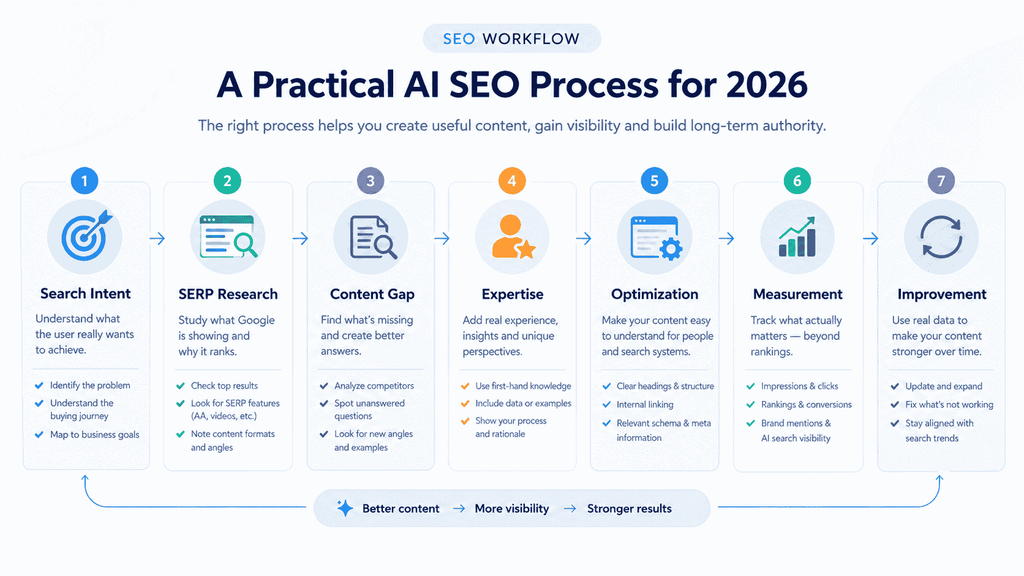
Step 1: Understand the searcher’s problem
Don’t start with the keyword alone. Understand the reason behind the search.
Step 2: Study the current search results
Look at what Google is actually rewarding for the query.
Step 3: Identify missing information
Find questions, examples, data or explanations competitors have not covered well.
Step 4: Add genuine expertise
Use your own knowledge, research, examples and observations.
Step 5: Create the clearest answer
Make the content easy to scan and understand.
Step 6: Connect the article to your website
Use relevant internal links to supporting resources and relevant service pages.
Step 7: Build external credibility
Earn relevant mentions, references and relationships rather than manufacturing them.
Step 8: Measure business impact
Track rankings, impressions, clicks, conversions and brand visibility.
Step 9: Improve the page after publishing
SEO is not finished when you press “Publish.”
Use real search data and user behavior to identify what needs improvement.
Frequently Asked Questions
Is AI replacing SEO in 2026?
No. AI is changing how search results are generated and consumed, but technical SEO, content quality, search intent and website accessibility remain important.
Will AI-generated content rank on Google?
AI-generated content can appear in search results, but using AI does not provide a ranking advantage by itself. The more important question is whether the content is useful, accurate, original where appropriate and created for people rather than primarily for manipulating rankings.
How do I optimize my website for AI search?
Start with strong traditional SEO fundamentals. Create clear, accurate and useful content, demonstrate expertise, organize information logically, maintain technical accessibility and build a credible digital presence.
Is keyword research still important?
Yes. Keywords remain useful for understanding what people search for. However, modern SEO should go beyond individual keywords and understand the problems, questions and decisions behind those searches.
What is the biggest SEO mistake businesses can make with AI?
Probably treating AI as a content-volume machine.
Publishing more content is easy now. Creating content that contains genuine expertise, useful evidence and a reason for the reader to trust it is much harder.
Final Thoughts
The biggest change AI has brought to SEO is not that machines can write articles.
It is that average information has become incredibly easy to produce.
That changes the value of expertise.
If everyone can create a basic article about SEO, the advantage moves toward the business that can explain a problem better, demonstrate experience, provide original evidence and earn trust.
That is why the strongest SEO strategy for 2026 is not:
“How much content can we produce with AI?”
It is:
“What useful knowledge can we create that people will trust, search systems can understand, and competitors cannot easily replicate?”
Use AI to make your workflow more efficient.
Don’t use it as a substitute for expertise.
SEO is still about being discovered. But increasingly, winning that discovery depends on giving people—and the systems that help them find information—a good reason to notice, understand and trust your brand.
Need Help Building an SEO Strategy for Your Business?
If your business is struggling to get consistent organic visibility, the solution is not simply publishing more AI-generated content.
You need a strategy built around your audience, search intent, competition, content opportunities and business goals.
NorthStar Marketing Hub helps businesses build their online presence through SEO, content marketing, paid advertising, social media marketing and lead-generation strategies. The focus is on understanding the business first, creating a tailored plan, executing it, measuring performance and improving what works.
Ready to Improve Your Search Visibility?
Let’s talk about your business, your current SEO situation, and the opportunities available to you.
→ Book a Call With NorthStar Marketing Hub
→ Explore Our Digital Marketing Services
No one-size-fits-all strategy. No unnecessary jargon. Just a clear discussion about what your business needs next.
Pingback: How to Optimize Your Website for Google AI Overviews & AI Mode in 2026 - Best Digital Marketing in India | NorthStar Marketing Hub
Pingback: Topical Authority in SEO: How to Build It in 2026